NEOGRAFT NEWS
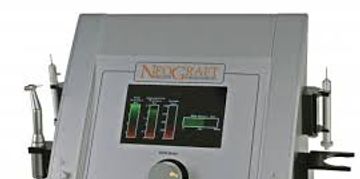
Dr. Bauman, the first doctor in the U.S. to publicly support NEOGRAFT has issued a warning on the internet concerning the use of the device by doctors with no hair transplant experience. Remember NEOGRAFT is just a tool, that speeds up the extraction of follicles. It does not produce a better hair transplant by itself. It will in the hands of experienced hair transplant doctors and tecnicians help them remove hair follicles faster. In Florida there are 2 doctors with many years of experience who use Neograft. Dr. Bauman in Boca Raton and Dr. Hirsh in Jacksonville, Sarasota, and Orlando. FUE has limitations, just as FU surgery has. It is up to the doctor to educate a prospective patient on the methods that can benefit him, and let the patient decide. Hair Transplant Techniques explained.
Recommended services for the start-up hair transplant doctor:
Hair Transplant Staffing: You found it.
Hair Transplant forceps to place follicular units into the smallest recipient sites from 0.6mm to 1.3mm are hard to find. Each technician has his or her preference, a lot of clinics and techs are not aware of some of the more advanced follicular unit forceps. The best forceps that I have found to place the smallest of grafts are the Leavitt Bonn and Miltex 18-836 and 18-837 forceps. I started using them years ago and every tech that borrowed mine were hooked and either bought a pair or had their doctor by them at an annual ISHRS meeting. These forceps will increase the speed at which you can place grafts, and increasing productivity is a good thing in this economy. These forceps are more expensive than others, but if you treat them well they will last for years, I have a few pair that I have used for 10 years.
Contact Florida based at 386-216-5429.
Finding a technically qualified hair transplant technician who can perform follicular unit hair transplants is not an easy task. Over the years hair transplant surgeons have had to utilize on the job training to achieve this, this type of training takes years to complete and is loosely structured without a curriculum to follow. We have changed that, since 1993 we have been developing hair transplant techs in the U.S. and in 2005 we introduced our hair transplant techniques at the ISHRS meeting in Sidney, Australia.
Training in follicular unit dissection and placement is offered to pre-screened R.N.'s, LPNs, Surgical technicians, and other clinically experienced medical personnel. We will not train non-medical staff in hair transplantation, as some hair transplant surgeons are doing. The students will be taught follicular unit dissection using
Mantis microscopes or High Definition Video dissection, which is above the industry standard in hair transplants. This training can be done in your office, saving you additional expenses sending out your staff to an off-site location.
Staffing is provided to hair tranplant surgeons who have had training in hair transplantation through the ISHRS or the AACS. Our
experienced hair transplant techs have over 20 years in this field and only perform the "gold" standard in follicular unit dissection and placement.
New study by Dr. Beehner confirms that follicular units with a small amount of surrounding tissue to protect the grafts provides for better growth than grafts that have been trimmed excessively. This confirms previous studies dating back to 1998. Excessive trimming of follicular units is a result of trying to achieve recipient site densities of greater than 50/cm2, and sometimes reaching 100/cm2. It takes time to see the results of new techniques in hair transplantation, 12-18 months, so go slow when implementing new technology and techniques that you learn at ISHRS meetings and workshops.
The 16th annual Live Surgery Workshop was held in Orlando, Fl. this week, the highlight of the meeting was the demonstration of the Neograft FUE device. This could have been the first time that the device was demonstrated at an ISHRS workshop. The device performed as I expected it to, it's rotary punch scored the skin around the follicular unit and the suction device, sucked it up into the canister. It appeared to me that if more tumescence was used, the extraction process would be faster, but I am not an expert on FUE. I should have asked Larry Leonard, what technique is fastest, as he is the best FUE technician in the country. Dr. Bauman form Boca Raton, Fl. was the doctor in charge of the Neograft FUE procedure. Dr. Bauman is the leading physician expert on the Neograft FUE device, and Al Tariq is the leading tech. Dr. Bauman was extracting grafts at a rate of 1 every 6 seconds, I don't think this was an accurate representation of the capabilities of Dr. Bauman or the Neograft FUE device. Dr. Bauman was performing the procedure with a room full of doctors and he was answering questions. After extracting a few hundred grafts, he turned the handpiece over to Al Tariq, Al Tariq was extracting grafts at a much higher rate, 1 every 2 seconds by my watch. For doctors wanting to learn Neograft FUE, I would tell them to go to Dr. Bauman, if technician services are needed for Neograft FUE you should contact Al Tariq, for all other types of FUE contact Larry Leonard. My thoughts about the Neograft device have not changed, it's true genius is the extraction process, if Neograft could seperate that part of the device and sell it for about 10,000 dollars it would be a tremendous success. The pneumatic insertion device is not needed, a good hair transplant tech with the best forceps can place grafts alot faster than the handpiece. Neograft in my opinion is an expensive piece of equipment, there is a need to automate aspects of the FUE procedure, so Neograft is trying to fill that need, but the demand for FUE is not that great yet. I believe a basic principle in marketing is to create a product that there is a demand for not to try and create demand for a new product. Time will tell if the demand for FUE can exceed 10% of hair transplant procedures.